Shakuntala Maheshwari’s Rooted Traditions and the Art of Everyday Life
Art often asks us to look longer at what we think we already know. A wall, a tree, a kitchen vessel, a field, a story heard in childhood, all can become more than background. In Shakuntala Maheshwari’s exhibition, these familiar forms become a way to think about memory, culture, and the living presence of tradition.
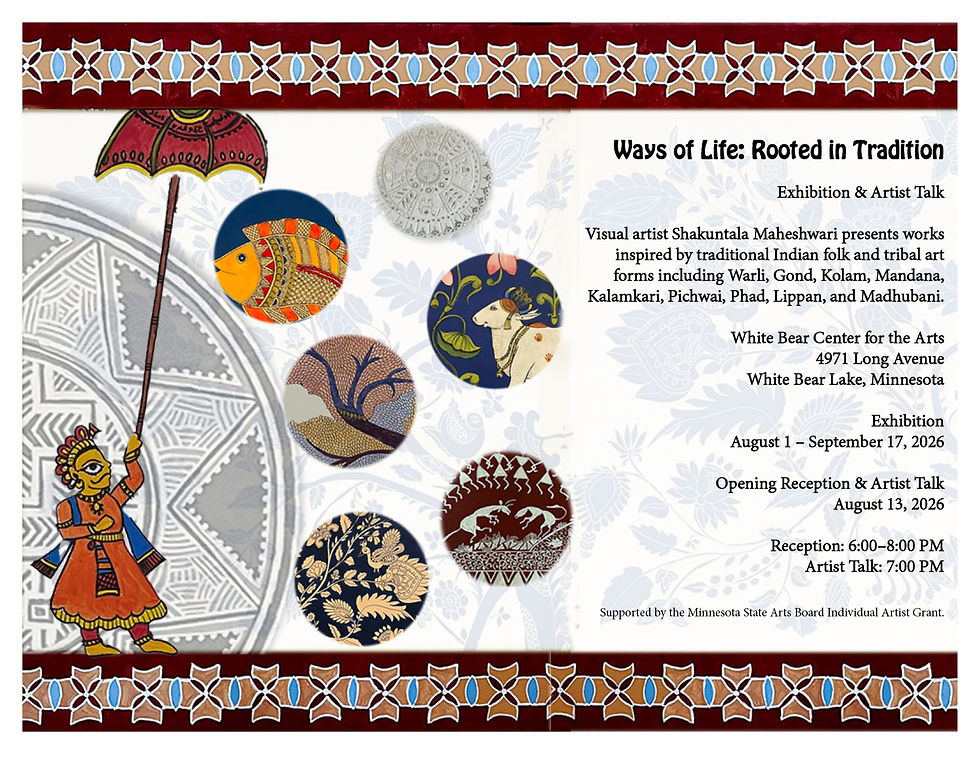
Shakuntala Maheshwari: Ways of Life - Rooted in Tradition opens with a reception on Thursday, October 29, from 6 to 8 p.m. at the Hopkins Center for the Arts. The exhibition presents a body of work by multidisciplinary artist Shakun Maheshwari, who draws on folk and tribal art forms from India to explore everyday living, shared values, and a spiritual connection to nature.
The phrase “rooted in tradition” can sound fixed, as if tradition belongs only to the past. Maheshwari’s work suggests something more active. Tradition is not a closed archive. It is practiced, revised, taught, remembered, and carried by hand. It lives in materials, in stories, in repeated gestures, and in the relationship between people and the natural world.

The exhibition begins with everyday life
Maheshwari’s exhibition focuses on a simple but rich idea: folk and tribal arts do not stand apart from daily life. They grow out of it.
In many Indian art traditions, image-making has long been tied to the rhythms of home, village, farming, worship, seasonal change, and family life. A painted wall may mark a festival. A floor design may welcome guests or honor a deity. A motif of a tree, bird, fish, or sun may speak to the cycles that shape human survival. These forms often carry beauty, but they also carry use, responsibility, and memory.
Tradition appears through practice, not nostalgia
Maheshwari’s relationship to these forms is personal as well as studied. Some of the traditions she uses have been part of her life since childhood. Others came through research and training with master practitioners.
Maheshwari’s approach respects knowledge as something earned through attention. Her work can be read as a dialogue between inheritance and learning, between what is carried from childhood and what is pursued through disciplined study.
Folk and tribal arts carry cultural memory
India’s folk and tribal art traditions are many and distinct. They come from different regions, communities, materials, and belief systems. Some are associated with ritual and seasonal observance. Some record myths, oral histories, social roles, or relationships with land and animals. Some began on walls, floors, cloth, or everyday objects before moving into galleries and museums.
When these traditions enter a contemporary exhibition space, they bring questions with them.
Maheshwari’s work sits within those questions. She is not simply preserving forms as if they were untouched objects. She is using them to explore continuing themes, including how human life depends on nature, how communities carry values, and how art can make belief visible.
Nature is more than a subject
One of the strongest threads in the exhibition is the spiritual connection to nature. In many folk and tribal traditions, nature is not treated as scenery. It is active. It gives food, shelter, medicine, weather, rhythm, and meaning. It is part of social and spiritual life.

The work resists narrow categories
Folk and tribal art forms can be technically refined, conceptually rich, and spiritually complex. They may use repetition, symmetry, flat space, bold pattern, and symbolic figures, but those qualities do not make them simple. They often encode ways of understanding the world that are both local and expansive.
By bringing these traditions into a contemporary art center, Maheshwari asks viewers to meet them with seriousness. The work belongs in a gallery not because it has been removed from daily life, but because daily life itself is worthy of artistic attention.
Learning from master practitioners matters
Master practitioners are not simply instructors of technique. In many traditional art forms, they are carriers of cultural context. They know when certain images are made, what symbols mean, how materials behave, and what responsibilities surround the work. They understand rules that may not be obvious to viewers.
Learning in this way shapes an artist’s relationship to the form. It can teach restraint as much as skill. It can also teach when change is possible and when respect calls for preservation.
Maheshwari’s practice reflects that balance. Her childhood familiarity gives the work personal roots. Her later study broadens those roots through research, mentorship, and sustained looking.
Why this exhibition feels timely
The themes in Shakuntala Maheshwari’s Rooted Traditions and the Art of Everyday Life reach beyond one artist’s biography. They speak to a wider hunger for connection, especially connection to land, memory, and slower forms of making.
Visiting the opening reception
The opening reception for Shakuntala Maheshwari: Ways of Life - Rooted in Tradition takes place on Thursday, October 29, from 6 to 8 p.m. at the Hopkins Center for the Arts.
An opening reception offers a particular kind of viewing experience. The work is new to the space, the artist’s ideas are fresh in the room, and visitors can often sense the relationships behind the exhibition. It is a time to look closely, ask questions, and notice how individual pieces speak to one another.
The most rewarding approach is not to rush toward interpretation. Spend time with the surfaces. Follow the line. Let the patterns settle. Ask what kind of world the work imagines.
A living thread between past and present
Maheshwari’s exhibition reminds us that tradition is not passive. It moves through people. It changes through use. It survives when someone cares enough to practice, study, and pass it forward.
In Ways of Life - Rooted in Tradition, folk and tribal arts become more than references. They become a way to honor everyday living, the wisdom of inherited forms, and the spiritual presence of nature. The work invites viewers to see art not as separate from life, but as one of the ways life understands itself.

Comments